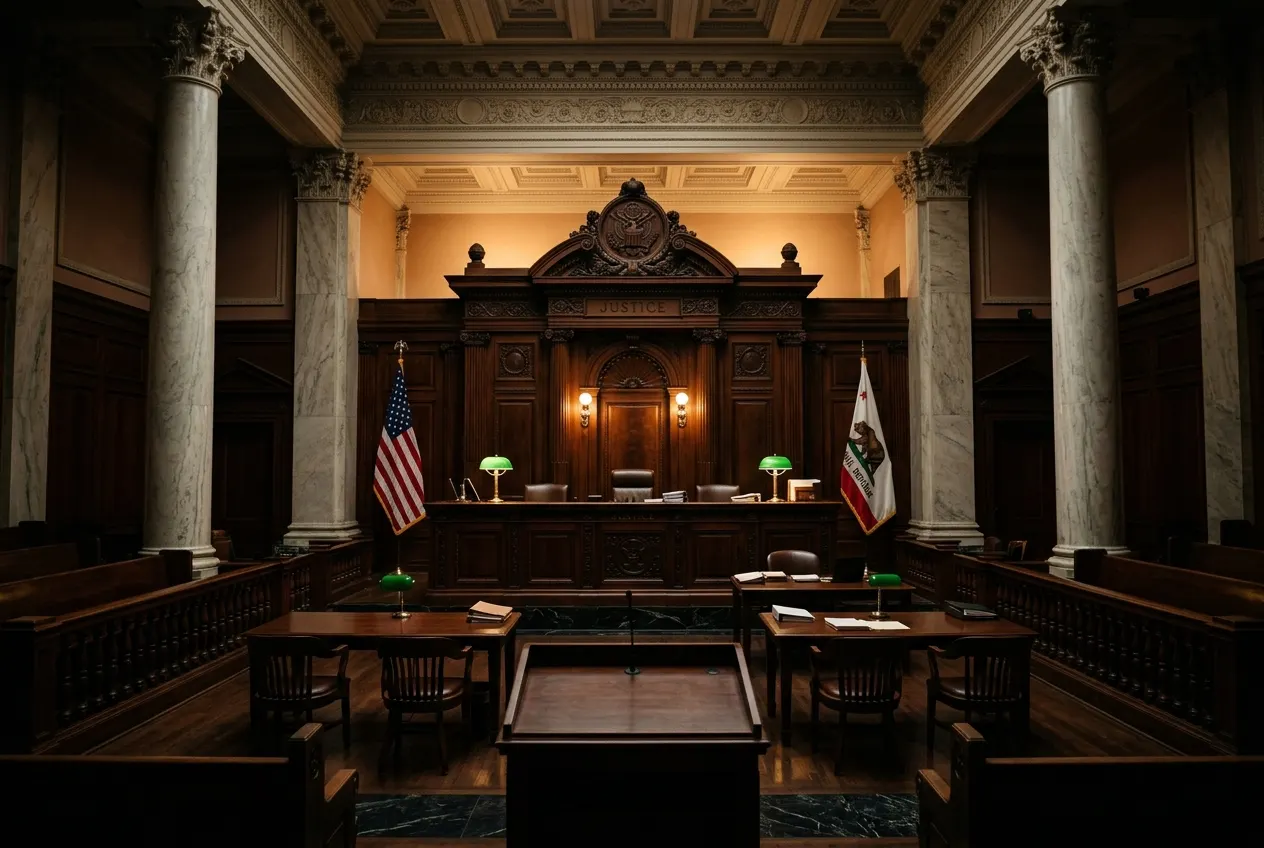
A Featured Profile · Published Under the First Amendment
The Hutson Chapter
Janet Bickel-Hutson — named in these pages and in active case filings as Janet Hudson — District Attorney, District 15, Muskogee County, Oklahoma. A woman this house is actively litigating against. And a comeback story this house refuses to disrespect.
On guard, with forethought · Federal question jurisdiction, 28 U.S.C. § 1331 · Enforceable through 42 U.S.C. § 1983
N.Y. Times Co. v. Sullivan, 376 U.S. 254 (1964) — debate on public officials shall be "uninhibited, robust, and wide-open."
Garrison v. Louisiana, 379 U.S. 64 (1964) — criticism of the official conduct of public officials is core protected speech.
Rosenblatt v. Baer, 383 U.S. 75 (1966) — government actors with substantial responsibility are public officials.
Phila. Newspapers v. Hepps, 475 U.S. 767 (1986) — on matters of public concern, the plaintiff bears the burden of proving falsity.
Milkovich v. Lorain Journal, 497 U.S. 1 (1990) — opinion on disclosed facts is protected; this page discloses its facts.
Snyder v. Phelps, 562 U.S. 443 (2011) — speech on public matters "occupies the highest rung" of First Amendment values.
Near v. Minnesota, 283 U.S. 697 (1931) — no prior restraint against publication.
Org. for a Better Austin v. Keefe, 402 U.S. 415 (1971) — no injunction silences criticism of public conduct.
Read this page the way it was written: under discipline. What follows separates three things and never mixes them — the verified public record (sourced), the allegations of one party in active litigation (labeled, contested, unadjudicated), and opinion (mine and the founder's, and identified as such). Ms. Hutson is a public official; commentary on the official conduct of public officials sits at the very core of the First Amendment. She is also a human being with one of the more remarkable second-chapter stories in Oklahoma law — and in this house, we respect the record even when we are across the caption from it. She is invited, at any time, to respond; her corrections will be printed verbatim.
The Fall and the Fight Back
Compiled from public reporting and official sources; every line below is drawn from the published record.
Begins in Muskogee as an intern in the District Attorney's office — then earns her chair as a prosecuting attorney serving Muskogee, Cherokee, Wagoner, Adair, and Sequoyah counties.
Appointed by the Oklahoma Attorney General as special prosecutor in the Baby Luke case in Pittsburg County — the kind of assignment that is only handed to a prosecutor who is trusted.
The fall. Charged in connection with methamphetamine, offering false evidence, and perjury; public accounts report a guilty plea. She surrendered her law license in 2007 and sought treatment and counseling.
The record is expunged. The long climb is underway.
Her law license is reinstated after formal reinstatement proceedings before the Oklahoma Bar — a door that does not open easily, or often.
Returns to the Muskogee DA's office as an assistant district attorney — back in the building where she started as an intern three decades earlier.
Appointed District 15 District Attorney for Muskogee County by Governor Kevin Stitt, filling the vacancy left by Larry Edwards. Her stated priorities: children's cases, domestic violence, and coordination with law enforcement.
Sit with that arc for a moment. A prosecutor who lost everything — license, standing, name — and instead of disappearing, did the treatment, did the years, did the reinstatement gauntlet before the Bar, and walked back into the same courthouse to carry the heaviest docket in the district. Whatever else is true, and whatever a federal court eventually finds in the matter below: that took a fight. This house knows something about fighting back. We recognize it when we see it.
What a Massive Undertaking It Must Be
Picture the room the way I would show it to you in a courtroom walkthrough: a district attorney's office covering a county's worth of human wreckage and hope — children's cases stacked beside domestic violence files, law-enforcement agencies pulling from every direction, victims calling, deadlines running, and every single charging decision carrying somebody's whole life inside it. The ethics required to sit that chair are not decorative. They must be of all-time value — because the prosecutor is the only lawyer in America whose sworn duty is not to win, but to see justice done. Her own history means she sits that chair knowing exactly what the power of that office can do to a human being. That knowledge should make a prosecutor better. This house publicly hopes — and expects — that it does.
McDermott v. Mulkey, Hudson — CV 2026-121 (E.D. Okla.)
Allegations of record — one party's sworn account · Contested · Unadjudicated
David Bruce McDermott II alleges, in a pending federal civil action in the United States District Court for the Eastern District of Oklahoma, that he was unlawfully prosecuted and held, and he names Ms. Hudson among the defendants. He further alleges that he was called to a private office meeting where his release was connected to the dismissal of his lawsuit — "David gets to go home if he dismisses his case" — an account he intends to prove in that proceeding. He also states that, having been told his calls from custody were recorded, he deliberately said certain things on those lines precisely so the record would preserve them. That is a litigant lawyering from inside a cell — make of it what the evidence will.
These are allegations by one party in active litigation. They are contested, no court has ruled on them, and Ms. Hutson — like every defendant — is presumed to have acted in good faith unless and until a court finds otherwise. This page will report what the court finds, whichever way it finds.
The Release — Read Charitably
Here is my professional opinion, offered respectfully and labeled as opinion: when Mr. McDermott was released, somebody with authority made that call — and the most coherent, most charitable reading is that she looked at the case and recognized something in it demanded correction. Prosecutors do not release people casually. If that reading is right, then the release itself was an act of the very ethics her office requires — seeing it, owning it, acting on it. She is responsible for that decision in the best sense of the word. It should be counted for her.
And consider what the released man did with his freedom. He did not hurt a soul. He went home and built iamthelawskunk.com — a free legal education house — and a courtroom where a skunk in a robe teaches America procedure. As threats to public safety go, this may be the funniest outcome in the history of the Eastern District.
"The prosecutor may strike hard blows, but he is not at liberty to strike foul ones." — Berger v. United States, 295 U.S. 78, 88 (1935). That standard is the whole conversation between this house and Ms. Hutson's office. We will hold her to it — and we will hold ourselves to it while we do.
One more thing, and it is the point of this entire page: her own story is proof that the system can hand a person back their scales. Judge Brett D. McSkunk's jurisprudence — you do right, you'll be done right; second chances are earned on the record — describes her arc before it describes anyone else's. A district attorney who was herself restored by grace now holds the power of mercy over others. We publicly wish her the wisdom to use it the way it was used for her.
Why This Page May Lawfully Exist
Question presented. May a citizen publish a profile of a sitting district attorney that reports the verified public record, states his own litigation allegations as allegations, and offers labeled opinion on her official conduct?
Short answer. Yes — this is among the most protected speech American law knows.
Argument. First, Ms. Hutson is a public official under Rosenblatt v. Baer, 383 U.S. 75 (1966): an elected-office district attorney holds substantial responsibility over the conduct of public affairs. Commentary on her official conduct therefore triggers the actual-malice regime of New York Times Co. v. Sullivan, 376 U.S. 254, 270 (1964), whose central promise is debate on public issues that is "uninhibited, robust, and wide-open." Garrison v. Louisiana, 379 U.S. 64, 74-75 (1964), extends that shield squarely to criticism of prosecutors.
Second, everything factual on this page is either drawn from public reporting and official records or expressly labeled as one party's litigation allegation. Under Philadelphia Newspapers, Inc. v. Hepps, 475 U.S. 767 (1986), the burden of proving falsity on matters of public concern rests on the plaintiff — and under Milkovich v. Lorain Journal Co., 497 U.S. 1 (1990), opinion resting on disclosed, true facts is not actionable. This page discloses its facts, labels its allegations, and signs its opinions.
Third, accurate reporting of allegations in a pending federal case — McDermott v. Mulkey, Hudson, No. CV 2026-121 (E.D. Okla.) — is reporting on a public judicial proceeding, a subject at the very center of public concern. Snyder v. Phelps, 562 U.S. 443, 452 (2011).
Fourth, no court may suppress this page in advance. Near v. Minnesota, 283 U.S. 697 (1931); Organization for a Better Austin v. Keefe, 402 U.S. 415 (1971). And any official who retaliates against its author for publishing it answers in federal court: jurisdiction under 28 U.S.C. § 1331, cause of action under 42 U.S.C. § 1983, with Houston v. Hill, 482 U.S. 451, 462-63 (1987), reminding every official that the freedom to criticize public officers verbally — let alone in measured print — "is one of the principal characteristics by which we distinguish a free nation."
Conclusion. This page was built on guard and with forethought — respectful by choice, protected by right. It asks nothing of Ms. Hutson except what the Constitution already guarantees everyone else: the record, kept honestly, in the open.
The Faces of Public Office
No permission slip is required to show America her own public servants. Official portraits of federal officers are public domain as works of the United States Government, 17 U.S.C. § 105; use of officials' images in news reporting and commentary is protected as newsworthy speech, Time, Inc. v. Hill, 385 U.S. 374 (1967), and commentary on public figures enjoys the fullest First Amendment protection, Hustler Magazine v. Falwell, 485 U.S. 46 (1988). Where a state portrait carries copyright, this house presents it under the fair-use doctrine, 17 U.S.C. § 107, for commentary on official conduct.
Official portrait of
District Attorney Janet Hutson
— frame reserved —
An Open Invitation to Ms. Hutson
Madam District Attorney: this page was written to be fair to you. If any line of it is wrong, say so — your corrections will be published verbatim, above the fold, unedited. The record is the record, for all of us.
Drafted by Atticus BradStreet McDermott · Reviewed under the house standard · Sources: public reporting and official Oklahoma records
Disclaimer: This page contains (1) facts drawn from public reporting and official records, (2) allegations made in active litigation which are contested and unadjudicated, clearly labeled as such, and (3) protected opinion and commentary on the official conduct of a public official. Nothing here is legal advice. Every case is sui generis.
© 2026 David McDermott · LAW SKUNK™ · McSkunkville™ · All Rights Reserved. All characters, lore, artwork and games — Atticus Bradstreet McDermott™, Judge Brett David McSkunk™, David Bradstreet McSkunk™, Jim McSkunk Rockford™, Hugh "Le Pew" McSkunkner™, The Firm, the McSkunkville Casino™ and Series One: The Case of the McSkunk Ruby™ — are original works protected under 17 U.S.C. § 101 et seq. Unauthorized reproduction or commercial use is prohibited.Sealed in the Copyright Vault →